
June 11, 2026
———————————————————-
As SWEEP marks its 25-year anniversary this year, there is so much to celebrate. A rich history of impact in advancing energy efficiency in all aspects of our society, from buildings and transportation to utilities and industry. A track record of persistence and partnerships in the six Southwest states where we focus our efforts. A talented and passionate Board and staff ready and able to tackle whatever challenges may arise.
And there’s even more to look forward to as we press ahead, eager to launch into SWEEP’s next 25 years.
But first, before we start blowing out birthday candles to celebrate this major milestone, let’s take a moment to reflect on where we’ve come from and how far we’ve traveled, as well as where we’re going next…
Where it all began – our humble beginnings
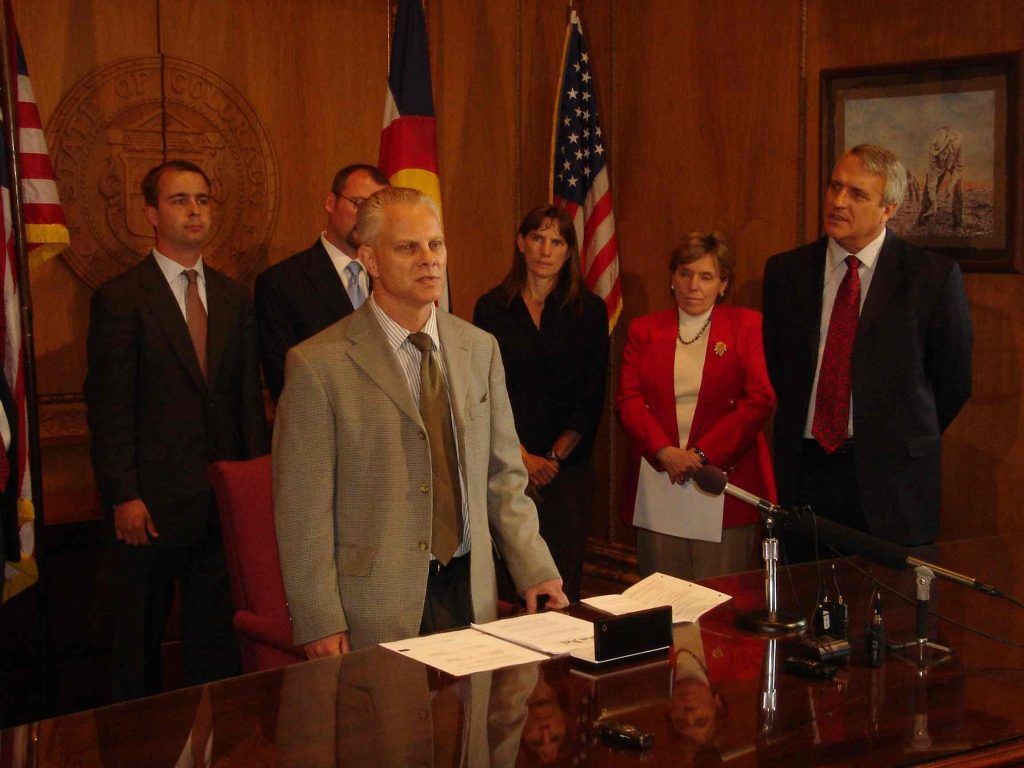
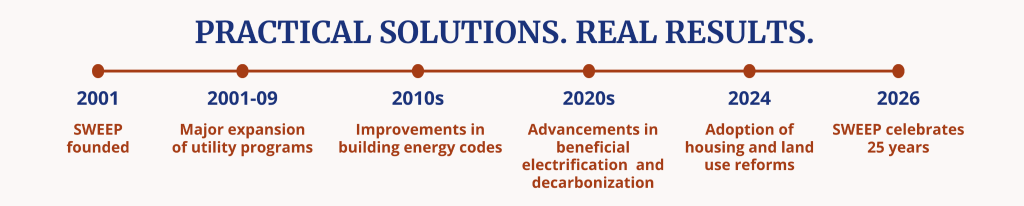
The story begins back in 2001, when SWEEP was just an idea in the mind of the organization’s founder, Howard Geller. Back then, the Southwest United States was well known for its scenic red rock desert canyons and alpine peaks, but not for its clean and efficient use of energy. A hub for fossil fuel extraction and use, the region was heavily reliant on coal-fired power generation and had a meager level of utility efficiency programs and funding. Howard, then Director of the Washington, D.C.-based American Council for an Energy-Efficient Economy, saw an opportunity to change that. He relocated to Boulder, Colorado, and founded the Southwest Energy Efficiency Project, more commonly known by its acronym, SWEEP.
In the ensuing 25 years, SWEEP has evolved from a one-person operation into a regional powerhouse, with 24 staff members and contractors, a budget of nearly $3 million, and leadership from Executive Director Elise Jones. In the process, we’ve helped transform how the Southwest uses energy — slashing waste, saving money, avoiding new power plants, and reducing emissions.
Who is SWEEP?
SWEEP works in the states of Arizona, Colorado, Nevada, New Mexico, Utah (in partnership with Utah Clean Energy (UCE)), and Wyoming, with major programs focused on buildings, transportation, utilities, smart growth, and industry. We are committed to ensuring a healthy, affordable, equitable, and low-carbon future for all by advancing energy efficiency, electrification, clean transportation, and smart growth solutions in our region.
Energy efficiency is SWEEP’s core principle. We pursue cost-effective solutions to make the energy used in buildings, industries, power generation, and transportation systems as efficient and clean as possible. At the same time, we define efficiency broadly. For example, for SWEEP an efficient transportation system requires electrifying cars and trucks while also reducing the driving of single-occupant vehicles; increasing multimodal options like transit, cycling, and walking; and supporting more location-efficient land use so people can live closer to where they work and shop.
As thought leaders and technical and policy experts, SWEEP staff produce technical reports, analyses, and articles about the latest efficiency technologies and programs, and advise policymakers and stakeholders on best practices for a clean energy future. We provide technical assistance to local building officials and city councils on cost-effective codes and standards. We also host workshops and other events so that utilities, policymakers, businesses, and energy efficiency experts can share information and learn from one another. And SWEEP embraces advocacy as a key tool in our toolbox, calling for policy change in state legislatures and intervening in public utility commission dockets to influence utility rates, programs, and policies.
Our work and its impact
Over its history, SWEEP has influenced the adoption of more than 200 state laws on topics ranging from efficiency standards to expanded funding and tax incentives. For example, in Colorado in just the last few years, we developed and championed successful legislation to advance commercial building benchmarking and performance standards, beneficial electrification in buildings, a statewide low-energy and carbon building code, reduced electric rates for heat pump users, a strategy for reducing unnecessary and costly gas infrastructure, a $120 million package of clean energy tax credits, and stronger standards for appliances and lighting products, as well as many other clean energy and decarbonization policies.
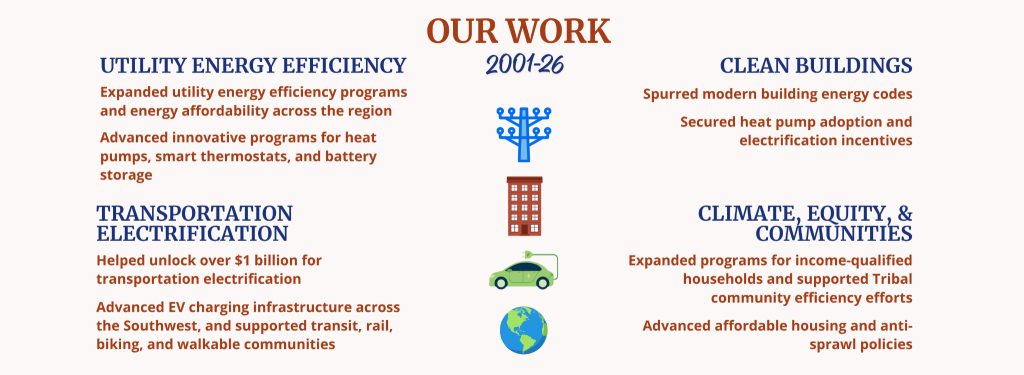
One of SWEEP’s biggest impacts has been working with, and when necessary pushing, utilities in the Southwest to adopt and expand robust, cost-effective efficiency programs that incentivize customers to reduce waste, embrace well-insulated and sealed homes, and install efficient lighting and appliances, including high-efficiency heat pumps and heat pump water heaters. By minimizing the amount of energy we use and shifting demand to times of day and year when it is less costly and less polluting, we help lower emissions and costs for consumers and businesses, making it easier to meet energy needs through clean renewable sources. In 2025, the major electric utilities in our region reduced energy use by more than 2,500 gigawatt-hours, providing nearly $1 billion in net benefits to customers.
SWEEP has also consistently been the region’s leader and go-to resource for helping states and local governments adopt stronger building energy codes. The easiest and cheapest time to make homes and buildings more energy efficient is when they are first being built. Wherever possible, SWEEP has supported amendments ensuring new construction is wired to accommodate electric vehicles (EVs), heat pumps, solar panels, and other modern technologies. Most recently, SWEEP was instrumental in supporting the State of Nevada, as well as jurisdictions in both northern and southern Nevada, with adoption of the 2024 International Energy Conservation Code (IECC), the most recent version of internationally-accepted model code. In neighboring Arizona, we assisted several large jurisdictions with adoption of the 2024 IECC, including several that approved strengthening amendments for EV infrastructure. Similarly, in Utah, SWEEP and our partner UCE successfully encouraged Salt Lake City to adopt a code ordinance requiring at least 20% of parking spaces at multifamily housing developments be wired for future EV charging. And just to the east in Colorado, SWEEP helped two cohorts of cities and counties on the Western Slope and Front Range develop and adopt advanced energy codes that encouraged high-efficiency and all-electric heating and water heating while improving comfort and ensuring lower energy bills for decades to come.
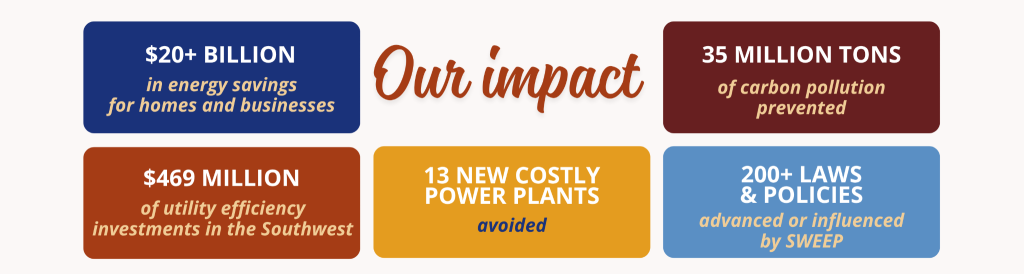
While SWEEP has always promoted programs and funding for low-income energy customers, such as home weatherization rebates, equity has become an even higher priority in recent years. Efficiency is key to addressing equity by making energy and mobility more affordable and accessible for low-income households and communities of color, which are disproportionately affected by climate change and pollution, while also delivering co-benefits such as improved air quality. SWEEP is working with Tribes in Arizona, Nevada, New Mexico, and Wyoming to advance building energy efficiency while honoring Tribal sovereignty, culture, history, and traditional building practices. In New Mexico, we helped pioneer a new approach to improving home comfort and reducing energy waste in disadvantaged neighborhoods through creation of the innovative Community Energy Efficiency Development Block Grant program.
Increasingly, another core focus for SWEEP is decarbonization, as the impacts of a changing climate are felt disproportionately in the Southwest in the form of historic droughts, extreme heat, severe weather events, and growing water supply challenges. Our decarbonization efforts include advocating for beneficial electrification — transitioning from fossil fuels to clean electricity where feasible and cost-effective in the buildings, transportation, and industrial sectors. For example, SWEEP helped advance state adoption of Advanced Clean Cars standards in Colorado and Nevada (with implementation underway in New Mexico) and Advanced Clean Trucks standards in Colorado (also in process in New Mexico) to accelerate the transition to lower-emission vehicles and cleaner transportation options. While federal policy changes have created new uncertainty for some clean transportation programs, state leadership remains critical to sustaining this progress. In addition, with SWEEP’s advocacy, the Colorado Public Utilities Commission approved both clean heat and beneficial electrification goals for Xcel Energy that will lead to investments of more than $640 million, driving a market transformation in low-emission heating systems in Colorado.
Partnerships are a core element of how SWEEP does its work. Through our SWEEP Allies Program, we collaborate with over three dozen clean energy businesses and nonprofits that are aligned with our mission and benefit from the work we do. Recognizing the pivotal role of skilled workers in implementing efficiency and electrification improvements, SWEEP also partners with utilities, HVAC contractors, and installers on workforce development and training opportunities. One example is our leadership of Colorado’s chapter of the Beneficial Electrification League, or BEL-CO, a coalition of stakeholders supporting the installation of energy-efficient electric equipment in buildings and industrial facilities.
What comes next – emerging issues
As we celebrate 25 years of impact, SWEEP is turning its focus toward the emerging challenges that will define the Southwest’s clean energy future. Chief among them is the explosive growth of data centers and the oncoming wave of artificial intelligence. Across our region, utilities are grappling with unprecedented demand. Salt River Project in Arizona faces more than 74 gigawatts of interconnection requests, NV Energy is projecting that its northern Nevada load could double in eight to 10 years, and similar requests are reshaping forecasts for Xcel Energy in Colorado and El Paso Electric in New Mexico. While data centers promise economic benefits, they also risk straining the grid, increasing reliance on fossil fuels, and raising costs for everyday customers.
SWEEP’s report, Data centers: Power needs and clean energy challenges, laid the groundwork on data center recommendations and how states can meet this challenge going forward in a responsible way for everyone in the midst of the ongoing energy transition. Looking ahead, SWEEP is championing environmental, consumer and community guardrails for these new large loads, combined with innovative solutions focused on turning data centers from grid-burdening assets into new demand-flexibility opportunities, with energy efficiency and demand-side management at the heart of the solution. By advocating for these approaches in utility proceedings and state policy, SWEEP aims to ensure data centers align with, rather than detract from, our decarbonization goals while protecting affordability and equity.
Over the last few years, SWEEP has become increasingly involved in smart land-use policies that lower housing costs, reduce emissions, and decrease driving by supporting more climate-friendly and efficient housing near jobs, transit, and other destinations. In 2025, SWEEP launched its Housing Forward Colorado campaign to support the effective implementation of state housing laws, advance local pro-housing policies, and serve as a central hub for housing advocates and policy professionals working on zoning reform, smart growth, and other housing initiatives. This campaign is now supported by four staff members and contractors, and maintains close partnerships with environmental and affordable housing organizations across Colorado. We have also expanded this work into Arizona, where we are helping to develop more environmentally friendly housing and land-use policies at the state and local levels. This year, SWEEP has officially created a new Smart Growth Program to coordinate these efforts across the region.
Toasting the future
For a quarter century, SWEEP has worked to elevate energy efficiency as a cornerstone of our clean energy, mobility, and equity goals. As a result, the Southwest is no longer a lagging region with respect to energy efficiency policy, action, and impacts. But much remains to be done, and we urge you to join us in this effort as we launch into our next 25 years of impact.


