
August 24, 2026
Chandler Sanchez & Matt Frommer
———————————————————-
Colorado is facing a number of transportation challenges, particularly along the Front Range, which is expected to add 1.3 million new residents by 2050. Congestion continues to worsen, transportation costs are rising, and transportation is the largest source of greenhouse gas (GHG) emissions in the state. At the same time, most Coloradans have few alternatives to driving, especially for longer trips along the Front Range.
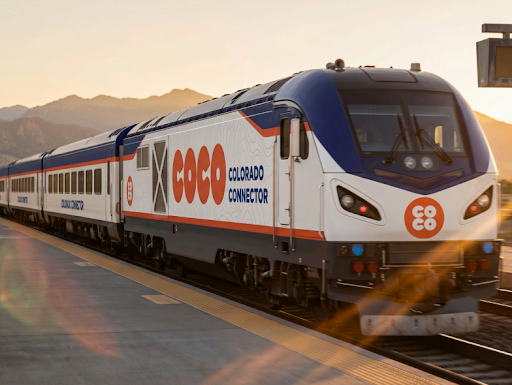
Front Range Passenger Rail, also known as the Colorado Connector or CoCo, is a proposed intercity rail project that would connect 13 cities from Pueblo to Fort Collins. Initial service would launch in 2029, with service scaling from three round trips per day to 10 at full buildout. The Front Range Passenger Rail District has been working closely with local governments along the route to lay the groundwork for walkable, transit-oriented communities around each station, creating anchors that can function as town centers.
Public transit is a critical piece of Colorado’s climate strategy, and Front Range Passenger Rail would build on a number of recent transit investments, including the expansion of Bustang, new state grants for local transit service, bus rapid transit (BRT), and other projects that are helping create a more robust and connected regional transit network.
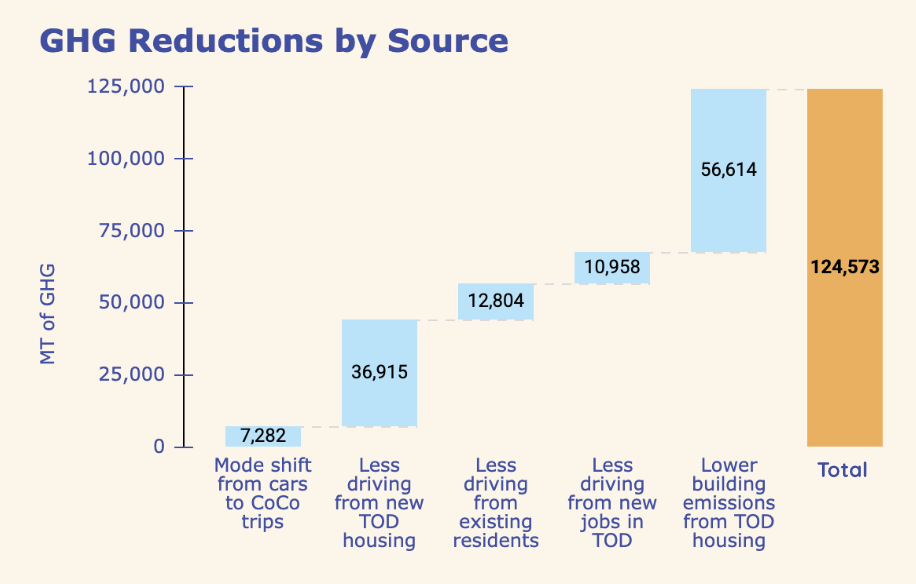
In our new analysis, we quantify the potential transportation and environmental benefits of Front Range Passenger Rail at full buildout. In a reasonably optimistic scenario, CoCo could reduce GHG emissions by roughly 124,500 metric tons per year by 2045 and eliminate nearly 233 million vehicle miles traveled (VMT) annually.
That’s the equivalent of taking 29,000 gas-powered cars off the road.
These reductions would come from two primary sources: replacing car trips with rail and, more significantly, catalyzing more compact, mixed-use development around the 13 planned rail stations. By enabling more people to live, work, and access daily needs in walkable, transit-oriented communities, CoCo could reduce driving, emissions, and energy and water consumption.
Mode shift: Replacing driving trips with rail
The most direct environmental benefit of CoCo is shifting trips from cars to trains. At full buildout, CoCo is expected to generate roughly 1.27 million passenger trips annually. The vast majority of these trips are expected to replace trips that otherwise would have been made by car. Our analysis estimates that this mode shift could eliminate approximately 30.7 million vehicle miles of driving each year.
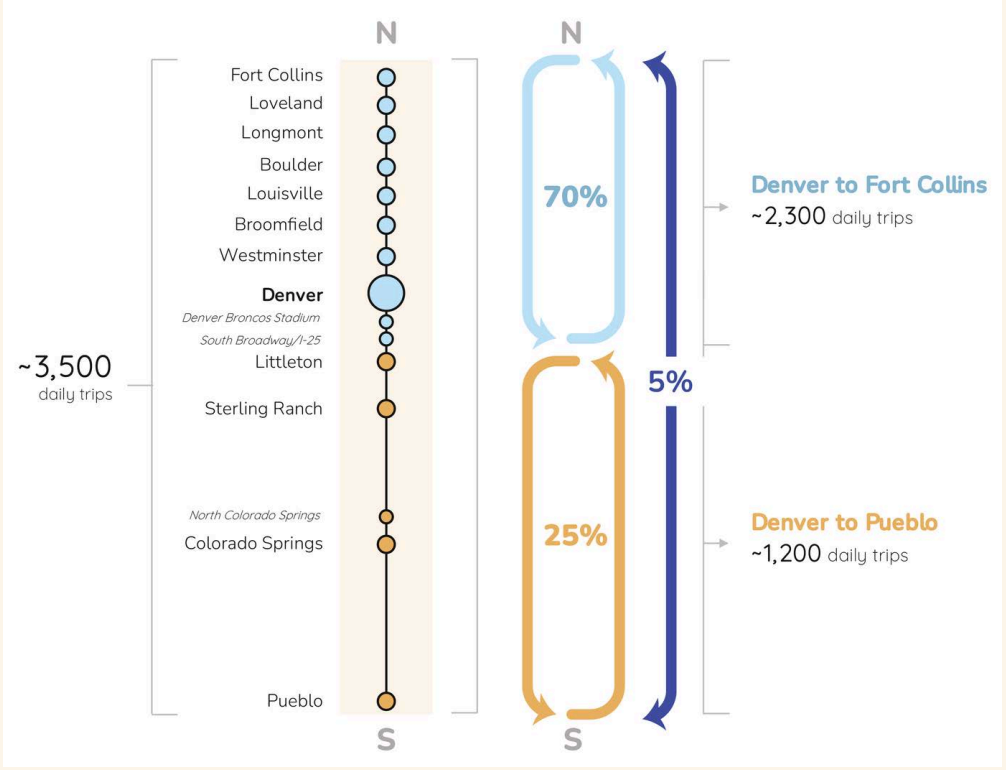
Colorado Connector ridership estimates. Source: Colorado Connector Service Delivery Plan
Avoided vehicle emissions are partially offset by new emissions from the train. CoCo is expected to use an Amtrak hybrid Tier 4 fleet, which is about 83% cleaner than comparative automobile travel. However, actual emissions reductions depend largely on the degree to which CoCo’s rail tracks are electrified. Today, only about 3% of the Front Range rail corridor is electrified – the stretch from Denver Union Station to Westminster. Electrifying more track would allow CoCo to take advantage of Colorado’s increasingly clean electricity grid and further reduce emissions from rail operations. In a scenario where the full corridor is electrified, our analysis estimates that the net emissions reduction from shifting trips from cars to rail would be about 7,300 metric tons per year.
These benefits could be larger if ridership exceeds current projections. Colorado has seen strong demand for intercity transit in recent years. For example, CDOT’s intercity Bustang ridership has increased fivefold since 2021, outpacing projections and demonstrating strong unmet demand for transit. In addition, similar rail projects in places like North Carolina, Wisconsin, and the Pacific Northwest have experienced significant ridership growth in recent years.
Land use is a force multiplier for transportation and climate benefits
Far and away, the biggest impact CoCo could have on driving and GHG emissions comes from the more efficient land use patterns around its stations. National studies estimate that the land use effects of transit reduce VMT and transportation GHG emissions by four to nine times more than mode shift alone. Our analysis found a similar result – the land use benefits of CoCo could reduce VMT and emissions 6.6 times more than the direct effects of shifting trips from cars to rail.
Over the past several decades, Colorado has accommodated much of its population growth through sprawling development on natural and agricultural lands. These development patterns increase driving and emissions, consume more land and water, and require costly new infrastructure. More recently, communities across the state have adopted zoning and land use policies that support more compact, mixed-use development near transit, partially in response to state laws such as the Transit-Oriented Communities law (HB24-1313) and Parking Reform law (HB24-1304).
That shift is increasingly important as Colorado grows. The State Demography Office estimates that 90% of the state’s population growth between 2025 and 2050 will occur in the Front Range, adding roughly 1.3 million new residents. CoCo’s 13 stations provide an opportunity to focus some of that growth in compact, walkable communities where residents can rely less on cars.
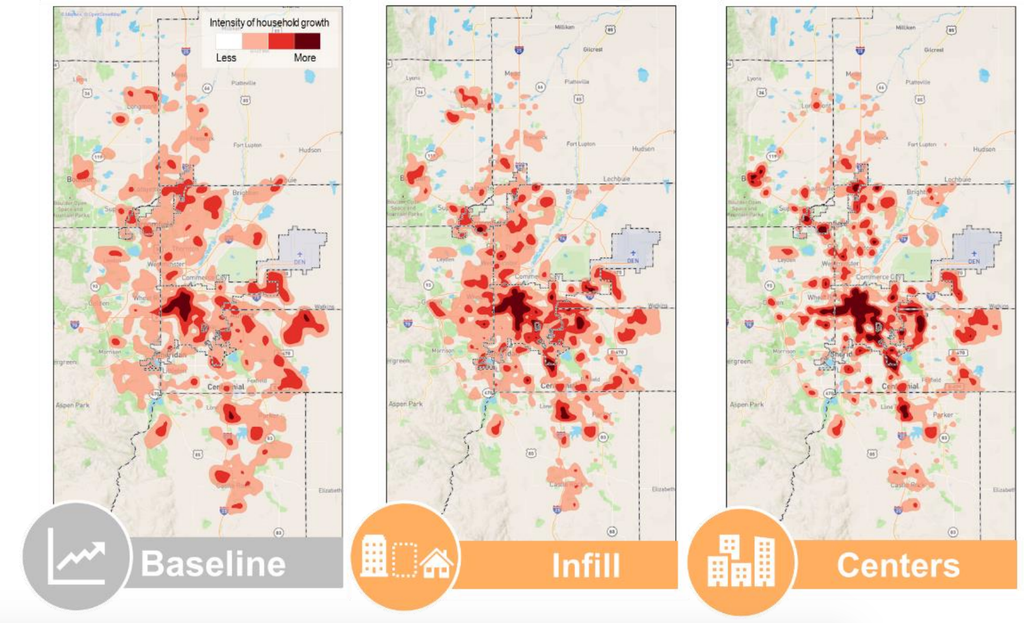
Source: DRCOG Metrovision Scenarios Modeling
These development patterns are well-aligned with regional goals to grow in more efficient, cost-effective, and environmentally-responsible ways. For example, the Denver Regional Council of Government (DRCOG) modeled several different land use and transportation scenarios for its 2050 Metrovision. The “Centers” scenario focuses 63% of housing growth near rapid transit, jobs, and urban centers in areas that make up 3% of the region’s land area. If combined with more transit, the Centers land use scenario would result in a 24% reduction in VMT, 6 times as many transit trips, and 3 times as many walking and biking trips than the Baseline scenario.
CoCo is one piece of a broader set of policies and investments to support more strategic growth near transit, and together, these strategies increase the likelihood of development around stations. For example, if voters approve CoCo, the project would include a $1.5 billion “local return” program that communities can use for transportation improvements, affordable housing, and other TOD-enabling infrastructure. Combined with state funding opportunities such as the HB24-1313 Transit-Oriented Communities infrastructure grants and HB26-1065 Transit and Housing Investment Zones, as well as more than $500 million in state affordable housing tax credits through 2033, these investments could help transform station areas into walkable, connected neighborhoods.
To estimate CoCo’s potential land use impacts, we analyzed station-area master plans and other local planning documents to project housing growth through 2045. Given the suite of TOD-supportive land use reforms and state investments, we chose an optimistic, high-growth scenario of more than 24,000 new homes within roughly a half-mile of CoCo stations by 2045.
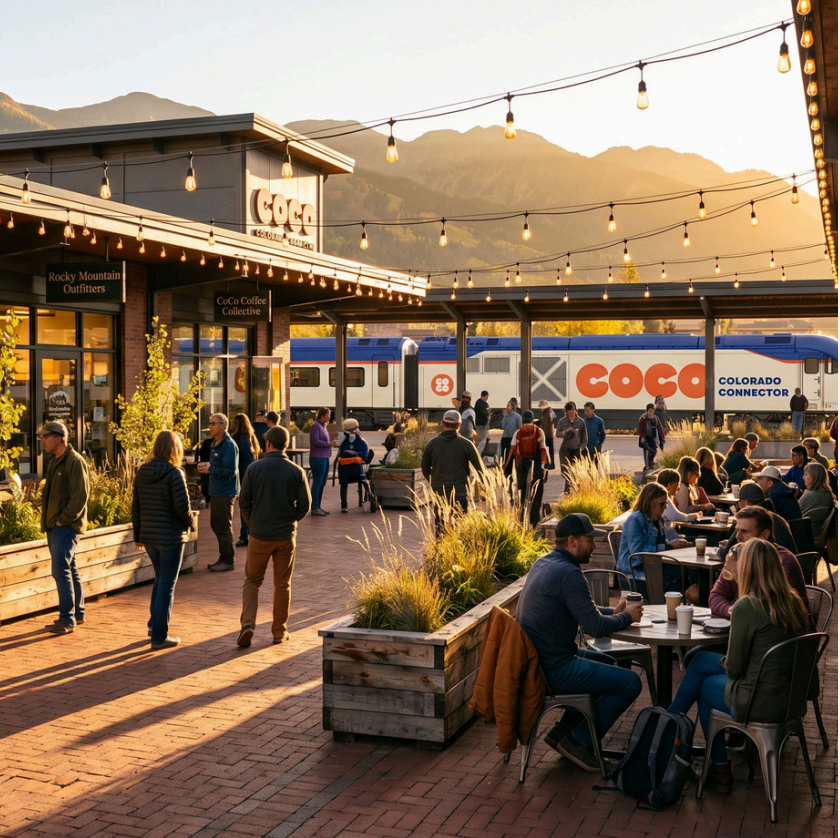
More housing near transit means less driving
The resulting reduction in driving could be substantial. Colorado households in transit-oriented communities drive about 30% fewer miles than the county average. Based on this differential, we estimate that households living in new households near CoCo stations could drive 123 million fewer miles each year, avoiding nearly 37,000 metric tons of GHG emissions annually.
The benefits extend beyond new residents to existing households in those transit-oriented communities. As station areas become denser and more mixed-use, new businesses, jobs, and services can locate closer to residents, allowing both new and existing residents to drive less. Our analysis estimates that this density effect could eliminate another 43 million VMT annually, avoiding approximately 12,800 metric tons of GHG emissions.
Lastly, new job opportunities around CoCo stations could further reduce driving. Assuming employment grows alongside new housing, we estimate that shorter commutes to jobs in station areas could save another 36.5 million vehicle miles annually, avoiding nearly 11,000 metric tons of emissions.
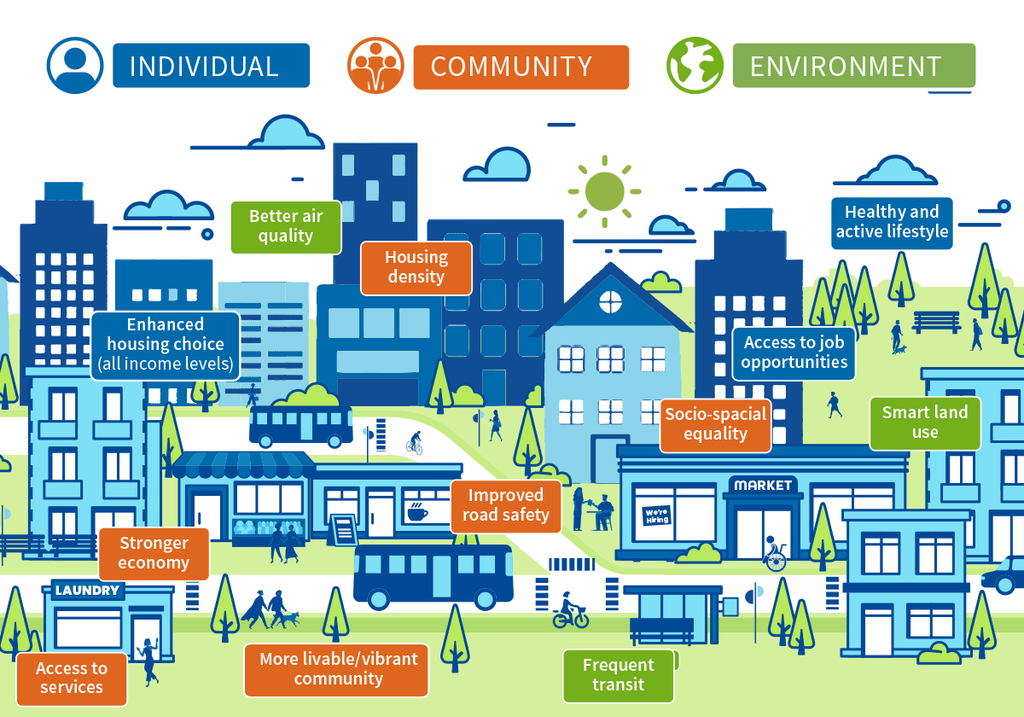
TOD is more than just convenient access to transit. Source: TriMet
Building communities where people don’t have to drive as much presents a major opportunity for Coloradans to save money on transportation, the second largest expense after housing. The state’s Strategic Growth Report found that households in urban neighborhoods and downtowns spend about half as much money on transportation as those in suburban areas, adding up to nearly $9,000 in annual savings per household.

Attached and multifamily housing types consume less energy and water
The type of housing built around CoCo stations matters too. The multifamily and attached housing types typically found in transit-oriented communities use approximately 70% less energy per household than detached homes, according to the Colorado Energy Office – savings that translate into lower energy bills. These housing types typically have less space to heat and cool, and share walls (and sometimes floors/ceilings), making them more energy-efficient. By accommodating more Front Range growth with these housing types, CoCo could reduce building emissions by an estimated 56,500 metric tons annually from new construction.
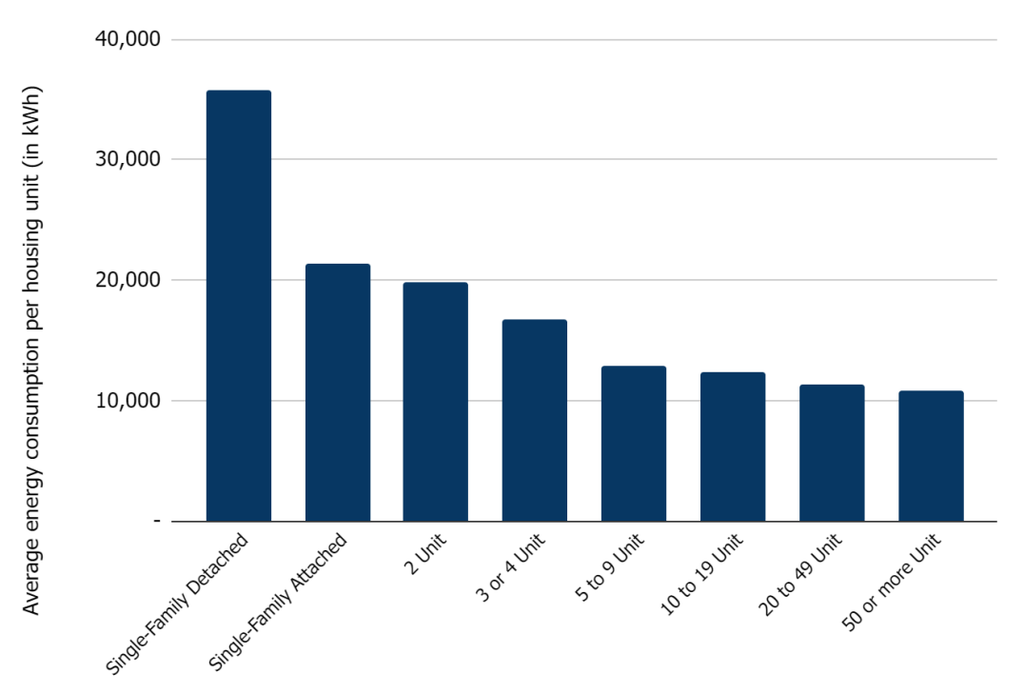
Average building energy use per housing unit in Colorado. Source: Colorado Energy Office’s Land Use and Climate Fact Sheet.
Denser housing also uses substantially less water because multifamily and attached homes typically require less outdoor irrigation than detached homes with large yards. The analysis found that new housing around CoCo stations could save approximately 2,396 acre-feet of water annually, or roughly 781 million gallons.
Finally, compact development reduces public infrastructure costs compared to low-density sprawl, which typically requires longer roads, utility lines, and water infrastructure, increasing both construction and long-term maintenance costs. One study of the Denver metropolitan area found that compact development could reduce infrastructure spending by as much as 80% compared with more dispersed growth, while also preserving farmland, forests, and wildlife habitat.
CoCo is a once in a generation opportunity for the Front Range – if we get it right
The Colorado Connector presents a once-in-a-generation opportunity for the Front Range to improve regional connectivity, sustainably accommodate future housing needs, and spur economic development around its stations. But realizing these benefits will require more than building the rail line. To ensure CoCo stations become thriving, walkable communities rather than empty park-and-ride lots, the Front Range Passenger Rail District, local governments, and transit agencies will need to collaborate on thoughtful planning and complementary investments. Key considerations include:
- Electrify the railway to provide a cleaner alternative to driving along congested interstates.
- Increase service frequency to make CoCo more competitive with driving and attract more riders.
- Expand local transit service around the CoCo stations to connect riders to the stations and their final destinations.
- Provide first- and last-mile connections for pedestrians and cyclists to make CoCo more accessible and convenient, and facilitate the development of more walkable neighborhoods.
- Enable compact, multifamily, and mixed-use development around stations by updating land use codes to encourage dense development, implementing state land use laws, and leveraging complementary financing tools such as the new HB26-1065 Transit and Housing Investment Zones program.
Front Range residents could have an opportunity to support the Colorado Connector project at the ballot box this November. For more information about our methodology check out our white paper, Quantifying the Environmental Benefits of the Colorado Connector.


