
May 26, 2026 | Matt Frommer & Chandler Sanchez
———————————————————-
On May 21, the Colorado Department of Transportation (CDOT) updated its 10-Year Plan, allocating billions of transportation dollars over the next decade that will shape how Coloradans travel for years to come. The Plan includes nearly 250 projects statewide, from repaving rural roads and building interchanges to widening highways and delivering high-quality transit. Colorado has strong goals and performance metrics for transportation, climate, and safety, some of which we’ve written about in the Southwest Energy Efficiency Project’s (SWEEP) past blog posts. However, Colorado’s real transportation priorities are reflected in its budgets, not aspirational goals, underscoring the importance of the 10-Year Plan.
When CDOT last updated its 10-Year Plan in 2022, we saw meaningful changes to the project list, suggesting a new approach to transportation planning in Colorado. This marked an earnest effort to meet our safety, affordability, and road quality goals as well as the new and ground-breaking greenhouse gas emissions (GHG) reduction rules adopted in 2021. The plan allocated significantly less money to costly highway expansions and redirected billions of dollars toward better aligned projects. For example, canceling projects like the I-25 highway widening in Denver freed up billions to spend on “fix it first” projects like resurfacing roads and repairing bridges, prioritizing the maintenance of our existing system over expensive expansion. CDOT and the Denver Regional Council of Governments (DRCOG) also committed to completing five Bus Rapid Transit (BRT) projects by 2030 and investing millions in Revitalizing Main Streets projects that improve pedestrian and bicycle safety and connectivity in downtown areas across the state. Even so, a much larger amount of funding was allocated to highway projects like the $905 million I-70 Floyd Hill expansion and the new highway lanes on I-25 North.
In September of 2025, SWEEP joined a coalition of multimodal transportation, safety, and environmental groups to create a Storymap calling for more investment in “fix it first,” multimodal, and transit projects. We proposed dedicating 30% of transportation funding to projects that support non-driving modes, such as transit, biking, and walking, while reserving the remaining 70% for “fix-it-first” priorities that repair and maintain existing roads and bridges, ensuring that infrastructure remains safe and functional.
In this report, we review CDOT’s updated 10-Year Plan and present recommendations for CDOT and other transportation planning agencies to deliver a more sustainable, affordable, safe, and equitable transportation system. It’s important to note that CDOT’s 10-Year Plan does not include all of Colorado’s transportation projects. Rather, it serves as a long-term planning and prioritization document, which is why it’s so important to track. A complete list of the state’s near-term transportation projects is included in the federally required Statewide Transportation Improvement Program, or STIP.
Colorado’s transportation goals: What we say we want
Last year, CDOT updated Policy Directive 14 (PD-14), its primary goals for the 10-Year Plan, to focus on three main priorities meant to guide the project selection process:
- Fix Our Roads: Improve highway pavement and bridge condition.
- Advancing Transportation Safety: Cut traffic deaths and serious injuries in half by 2037, including from Vulnerable Road Users (VRU) like pedestrians and cyclists.
- Sustainably Increase Transportation Choice:
- Expand statewide transit service by 83% by 2037 (6% annual increase),
- Reduce vehicle miles traveled per capita by 1% per year, and
- Cut transportation GHG emissions by 60% by 2037 from the 2005 baseline.
These priorities also reflect how the public wants CDOT to spend our transportation dollars. In 2025, CDOT hosted a series of telephone town halls to understand how Coloradans want the department to invest its funding. Respondents strongly favored a more diversified budget, with 37% allocated to transit, biking, and walking, 33% to road repair and maintenance, and just 13% to highway expansion – far less than the highway allocation in CDOT’s previous 10-Year Plan. In addition, statewide polling from March 2025 found that a majority of voters would prefer more investment in public transit over building and expanding roads – 55% to 45%.
CDOT deserves credit for making progress on road and bridge conditions. For example, the share of interstate pavement in poor condition fell from 3.9% in 2020 to 1.6% in 2025. It will require sustained investment in repairs and maintenance to bring that below CDOT’s 1% target.
Colorado has been less successful on the safety front. As you can see below, traffic deaths and serious injuries have been rising over the last few years, and new data found 2025 deaths were even higher than 2024. The dashed orange line represents CDOT’s goal for 2037 – a 50% reduction from the 2023 numbers.

Source: CDOT’s PD-14 Goals Dashboard. Note: VRUs are defined as “individuals who use the roadways but lack the physical protection of a vehicle.”
Expanding statewide transit service by 6% per year may prove similarly daunting, especially given the transit service cuts during the COVID-19 pandemic and the ongoing challenges of rebuilding ridership and securing more transit funding to grow service.
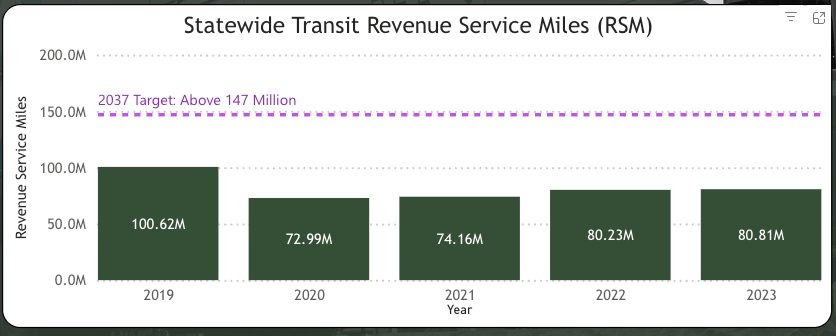
Still, the CDOT Plan includes over $10 billion worth of transportation projects, so it’s entirely possible to meet these goals if spending is well-aligned with budget decisions.
This comes as Colorado falls behind on its climate targets, particularly in transportation, the state’s largest source of GHG emissions and a major contributor to local air pollution that disproportionately harms communities near highways. Colorado’s most recent GHG Progress Report projects transportation emissions to be 24 million metric tons (MMT) by 2030, 6 MMT above our state target. As Colorado experiences one of the hottest years on record, with low snowpack and heightened wildfire and drought risk – all while the federal government rolls back key electric vehicle and fuel-efficiency programs – this should serve as a wake-up call. CDOT must take immediate action to reduce transportation emissions.
Expanding options beyond driving is also an important opportunity to save people money at a time when cost of living and affordability are top issues facing Coloradans. A 2024 CDOT study found that reducing household driving by 10% would save Coloradans $25 billion over the next decade, mostly through lower vehicle ownership costs and fewer crashes. A household that shifts from two cars to one could save as much as $12,000 annually, potential savings that continue to grow alongside rising gas prices.

Source: Colorado Transportation Vision 2035 and SWEEP
Lastly, it’s important to acknowledge that not everyone has reliable access to a car. In fact, roughly 1 in 3 Coloradans over the age of 10 do not or cannot rely on a personal vehicle to meet their daily travel needs, including over 160,000 people of driving age who live in homes without any personal vehicles.
CDOT’s updated 10-Year Plan largely maintains the status quo
Despite Colorado’s many pressing transportation challenges, and CDOT’s strengthened goals, its updated 10-Year Plan is largely more of the same. CDOT continues to spend far too much on highway widening at the expense of road repairs and multimodal transportation.
CDOT 10-Year Plan: Share of spending by project type

Road safety, repairs, and maintenance account for nearly 50% of the 10-Year Plan budget, while road capacity projects account for 36% and Transit and Multimodal Transportation combine for 15%. Source: Draft FY27-36 10-Year Plan.
Over-investment in highway expansion continues to crowd out maintenance and multimodal options.


The 10-Year Plan includes roughly $3.7 billion in highway widening projects. While many of Colorado’s highways need repair, decades of research show we can’t build our way out of congestion with more highway lanes. When we make it easier to drive, more people choose to do it and traffic often returns to pre-construction levels within just 3–5 years. According to the US Department of Transportation, every 10% increase in highway lane miles results in a 7% increase in vehicle travel in the short-term and a 10.6% increase in the long-run, erasing most if not all of the promised congestion relief. In addition, every mile of new highway lane adds a long-term maintenance obligation of over $24,000 per mile per year.
Many of CDOT’s proposed highway expansions involve Express Lanes on I-25 and I-270, which generate toll revenue to help offset project costs over time. Some of these Express Lanes also allow buses to bypass traffic, providing a more competitive alternative to driving. However, the additional car travel filling up the new highway lanes likely outweighs many of the environmental, congestion, and transit benefits associated with the transit improvements. And while new Bustang mobility hubs and Express Lanes can improve transit quality, those benefits remain largely theoretical unless they are paired with significant increases in transit service so buses run more often, earlier in the morning, and later at night – improvements that are largely absent from the 10-Year Plan, as Bustang and other transit operators struggle to maintain even current service levels (more on that later).
Even so, CDOT’s single largest project investment in its 10-Year Plan would add another general-purpose lane, not an Express Lane, to I-25 between 84th and 104th Avenues in Thornton, widening the highway from eight to 10 lanes along a corridor that already includes an Express Lane.
Every dollar spent on new highway lane miles is a dollar not spent on “fix-it-first” maintenance projects that repave roads, fill potholes, and save people money on car repairs. Colorado currently ranks 28th in pavement condition on urban interstates and 47th on rural interstates. Driving on rough roads costs the average Colorado driver $831 annually in additional vehicle operating costs – a total of $3.7 billion statewide. While CDOT has reduced the share of interstate pavement in poor condition in recent years, the overall backlog remains.
Prioritizing highways also comes at the expense of transit, bicycle, and pedestrian projects. To get an idea of the opportunity cost, completing the seven unfunded BRT projects in DRCOG’s Regional Transportation Plan – over 82 miles of BRT – would cost $554 million, which is $250 million less than the planned 6.5-mile highway expansion on I-270. This map includes 12 BRT projects that are either planned or under construction in the Denver metro area:

Very little funding for pedestrian and bicycle safety projects.
The proposed 10-Year Plan makes minimal progress toward improving safety for vulnerable road users, with bike and pedestrian projects only accounting for 2% of future spending. This follows recent state budget cuts of $81.9 million from the Multimodal Transportation and Mitigation Options Fund and $7 million from CDOT’s Revitalizing Main Streets program, as well as lower federal allocations from the Safe Streets for All program. Historically, these are our main sources of funding for smaller-scale investments like sidewalk expansions, main street upgrades, downtown public plazas, trail expansions, transit stations, and bike lanes that directly benefit local communities, save lives of our most vulnerable road users, and improve quality of life.
Meanwhile, vulnerable road user deaths and serious injuries have risen by 72% since 2020. Pedestrians account for only 8% of trips but 19% of Colorado’s traffic fatalities. If CDOT is serious about improving safety, it must meaningfully invest in infrastructure that supports safer ways to travel.
Transit: Big vision, not enough funding
The updated plan includes an impressive list of more than $1.2 billion of transit projects over the next decade, but only allocates enough funding to deliver about 25% of them, excluding the most expensive rail projects that don’t yet have a project cost estimate. These 68 projects include mobility hubs, transit centers, fleet expansions, Bustang service improvements, and BRT corridors, yet only 10 receive any CDOT funding over the next decade.
More than two-thirds of CDOT’s committed transit funding, or $218.8 million, is dedicated to the Federal Boulevard BRT project serving Denver, Englewood, Adams County, and Westminster. Another $21 million is allocated for the Colorado Boulevard BRT project in the 2031–36 timeframe. In the previous version of DRCOG’s regional transportation plan, this project was scheduled for completion by 2030, making this delay a notable setback. Both projects depend on federal funding, adding uncertainty and additional implementation challenges.
When CDOT last updated its 10-Year Plan in 2022, one of the biggest takeaways was adding five BRT corridors for completion by 2030, a major win for transit advocates. However, roughly eight additional planned BRT corridors in the Denver metro area remain entirely unfunded, and none were advanced in the updated plan, likely pushing construction into the late 2030s or even the 2040s.
The bigger transit story this year, however, is the inclusion of several potentially transformative, though still underfunded, intercity transit and rail projects:
- Bustang: The growing intercity bus network, now operating over 20 routes across Colorado.
- Front Range Passenger Rail: Full train service connecting Pueblo, Colorado Springs, Denver, Boulder, Fort Collins, and other Front Range communities.
- Mountain Passenger Rail: Service from Denver to Winter Park, eventually extending to Steamboat Springs and Craig.
Bustang is one of Colorado’s clearest transit success stories over the last few years. Expanded routes and increased frequencies have grown ridership by five times since 2021. Although intercity driving accounts for just 3% of trips, it makes up 30% of vehicle miles traveled, making services like 70-160+ mile Bustang trips highly effective at reducing congestion, emissions, and roadway wear.
Unfortunately, Bustang lacks a dedicated, long-term funding source and a clear growth plan, which we explored in depth this March. The recent service expansion was largely supported by temporary funding from 2022 legislation to increase frequency and add routes statewide – funding that expires this year, leaving a $25-30 million gap, around half of the total budget. CDOT is using temporary funding to keep Bustang service afloat over the next year while it works toward a more permanent solution to avoid drastic cuts in service.

Source: CDOT September 2025 presentation to the Transportation Legislative Review Committee
The two other major transit additions to the 10-Year Plan are Front Range Passenger Rail and Mountain Passenger Rail. In April, CDOT, the Regional Transportation District (RTD), and railroad operator BNSF Railway reached an agreement to partner on delivering “joint service,” marking the first step toward launching future passenger rail between Denver and Fort Collins. Under the current plan, three daily round trips would begin in 2029 without requiring new taxes or fees, with costs shared by RTD and CDOT enterprises. Meanwhile, a separate proposal for a more robust Front Range Passenger Rail system with nine to 10 daily trips extending from Pueblo to Fort Collins could go before voters this November and would be funded through a new sales tax.
Outside the Front Range, Mountain Passenger Rail from Denver to Winter Park and Steamboat Springs could improve accessibility and support economic activity in mountain communities seeking revitalization. CDOT and the Colorado Transportation Investment Office have already invested rental car fee revenue into startup service, but making the project a reality will require far greater long-term investment.
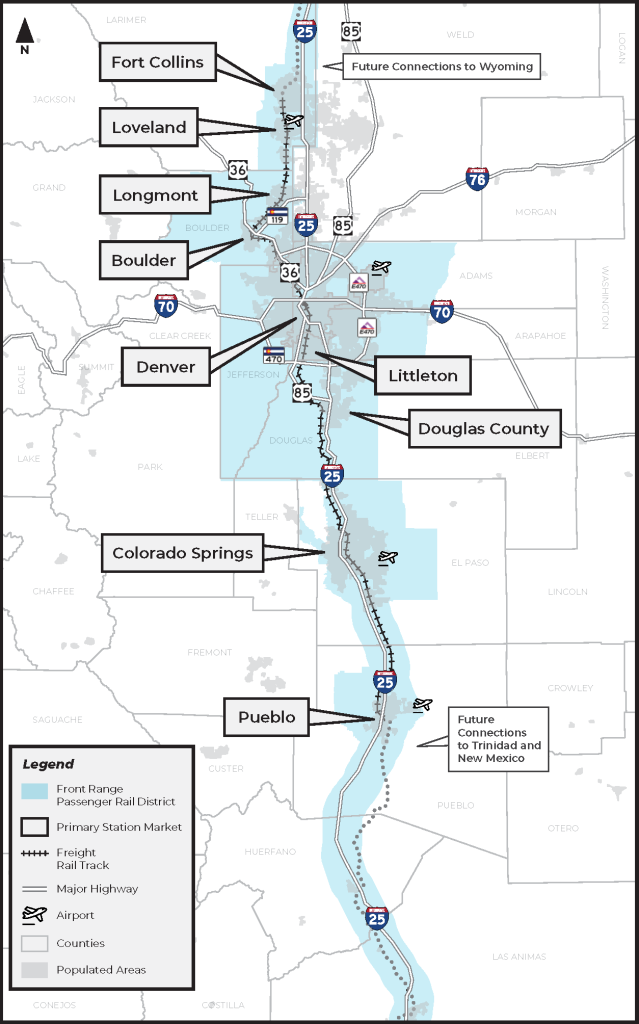
Source: Front Range Passenger Rail District
To meet the moment on transportation, Colorado should:
1. Fund Bustang long-term and integrate transit into highway investments
Highway expansion alone will not solve congestion without viable alternatives to driving. Colorado should better integrate transit, active transportation, and transportation demand management strategies into highway projects while creating a long-term funding source to expand Bustang and other interregional transit services. One option is dedicating surplus Express Lane toll revenue to bus operations and first- and last-mile connections along major corridors, helping build a BRT-like network on key interstates that improves mobility and reduces emissions. The state could also support expansion by shifting federal highway funds to transit or creating a Bustang Enterprise with dedicated revenue, similar to the Clean Transit Enterprise. Where appropriate, Colorado should also consider converting existing general-purpose lanes into Express Lanes to improve reliability and generate funding for transit and multimodal projects.
2. Accelerate deployment of “real” BRT
BRT works best when buses have their own lanes, allowing them to bypass traffic and provide a faster, more reliable alternative to driving. Dedicated bus lanes work, yet the proposed Federal Blvd BRT will share lanes with car traffic for 25% of the corridor and potentially a larger share for the Colorado Blvd BRT. A dedicated bus lane on Colorado Boulevard is expected to double transit ridership, reduce severe and fatal crashes along the corridor by 30%, and make transit service 25–35% faster.
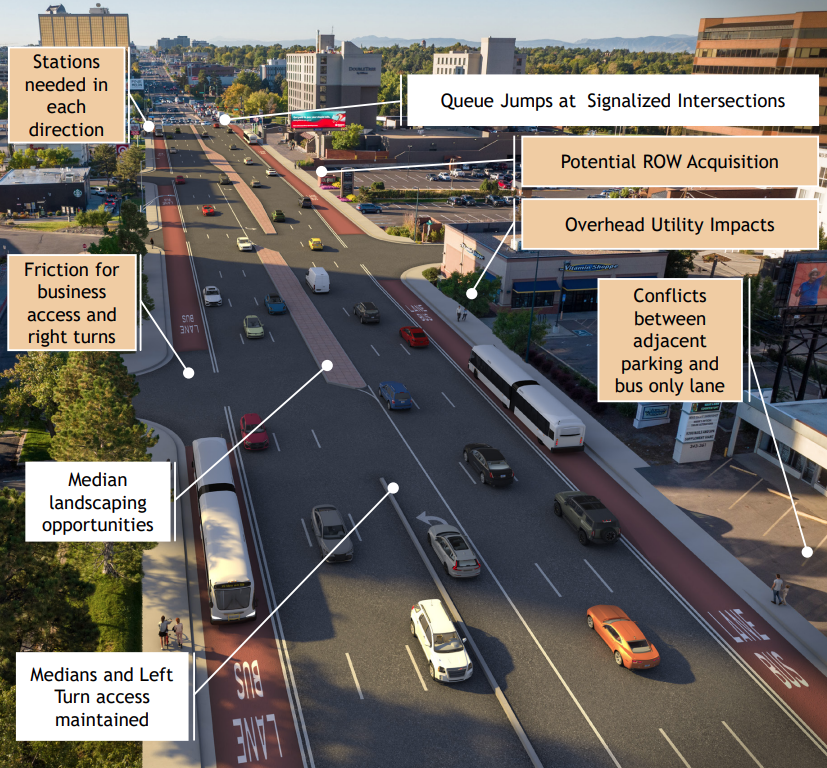
In addition, Colorado should accelerate high-impact BRT projects that local governments have identified as top priorities but currently lack funding. Projects in Aurora (Havana/Hampden), Denver (Alameda and Speer), Fort Collins (West Elizabeth and North College Avenue), and Colorado Springs (Nevada Avenue) present major opportunities to reduce regional vehicle miles traveled and create more efficient, sustainable transportation systems.
3. Build a connected passenger rail and transit network
Much work remains to turn Colorado’s passenger rail vision into reality. CDOT must partner with regional transit agencies to ensure rail service is not only financially viable, but also fully integrated with the state’s broader transit network. That includes coordinating with local agencies like RTD and Transfort in Fort Collins to provide strong connections from rail stations to final destinations, while working with local governments to support transit-oriented development and first/last mile access.
4. Prioritize active transportation
Active transportation projects remain severely underfunded in CDOT’s budget and planning, despite their major benefits for climate, safety, public health, and quality of life. These projects are largely absent from the 10-Year Plan, and the state legislature recently reduced funding for the Multimodal Options Fund and Main Streets grant programs. CDOT should develop a statewide bike and multi-use trail network with the same level of priority and long-term planning given to the interstate highway system, connecting communities across Colorado. The Utah Rail Network offers a strong model by pairing an ambitious vision with sustained funding and implementation.
5. Fund local and regional transit
Ultimately, meeting CDOT’s goal of expanding transit service by 6% annually will require a substantial increase in funding for RTD, which provides roughly two-thirds of the state’s transit service, as well as other medium- and large-sized transit agencies. To its credit, CDOT’s Clean Transit Enterprise recently awarded the first round of SB24-230 Local Transit Operations grants to expand service statewide, including $9.3 million for RTD, a figure expected to grow in 2027.
However, current funding levels remain far below what is needed to meet Colorado’s transit demand. Other states have invested far more aggressively in local transit, often shifting federal transportation dollars from highway expansion to transit operations and service improvements. Alliance to Transform Transportation, a coalition of community, environmental, and multimodal transportation advocates, is calling for an additional $420 million annually to double transit service in the Denver region. Most of that funding would support expanded operations and dramatically increase the share of residents within a 10-minute walk of frequent transit service.
Conclusion
Colorado has set clear goals to expand transportation choices beyond driving in order to build a safer, cleaner, more affordable transportation system. As it currently stands, CDOT’s drafted 10-Year Plan is unable to achieve that vision. The plan’s overcommitment to expensive highway projects leaves transit, bike and pedestrian, and future rail projects woefully underfunded over the next decade. Balancing our spending to invest more in projects that expand transportation choices better meets the moment, enabling CDOT to actually deliver on building a more efficient, affordable, and sustainable system.


