
January 23, 2026 | Jim Meyers, Building Efficiency Specialist
———————————————————-

I have been participating in the development of the International Energy Conservation Code (IECC) since the first decade of the new millennium. I have been a member of the IECC development committees and the International Code Council (ICC) Sustainability Energy High Performance Code Action Committee. I have weathered many challenges and code changes over these years. But the recent announcement for the ICC Board regarding the 2030 IECC represents a fundamental shift that should give every building efficiency supporter and code official pause at the complexity being added to the development and adoption of future energy codes.
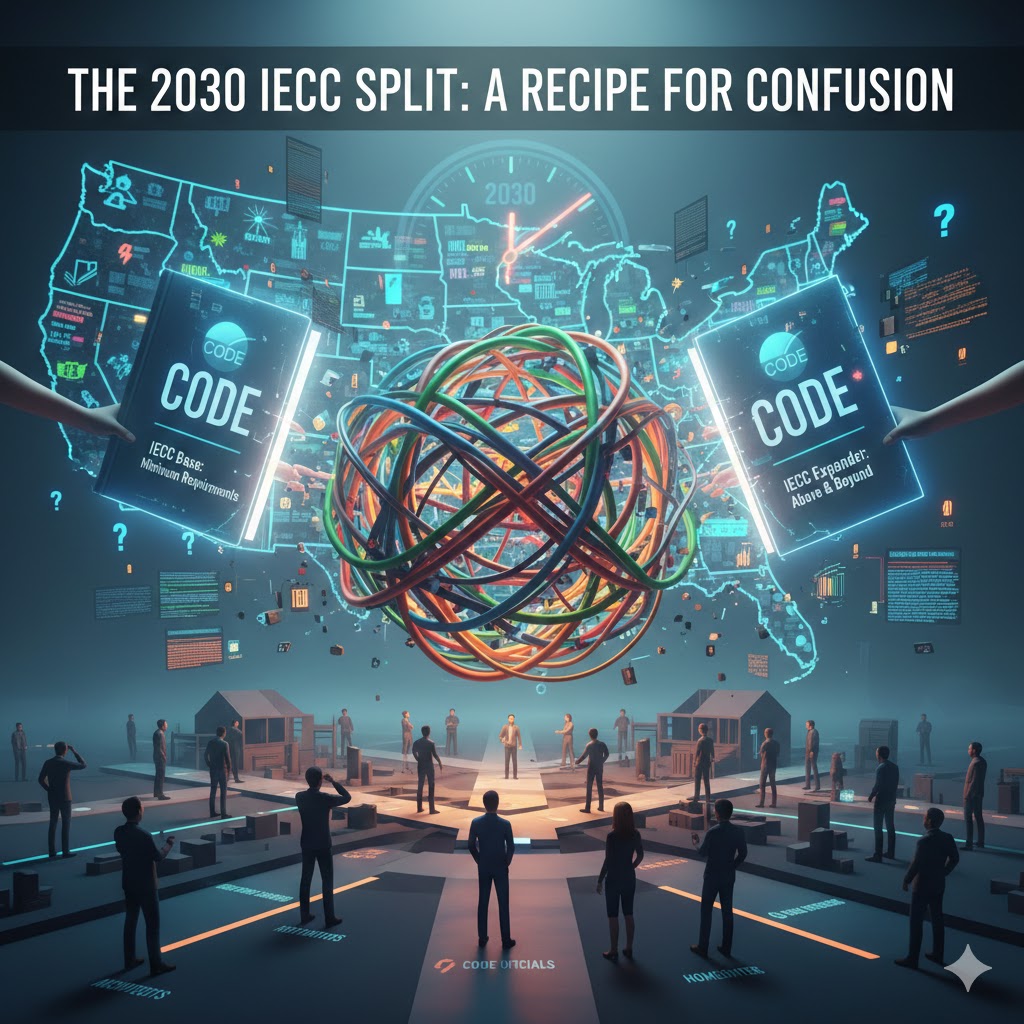
The ICC Board has created a new framework that splits the IECC into two documents: a “base” IECC and an IECC Expanded (IECCX). While the idea is to provide “varied options” depending on the state, the “minimum vs. additive” strategy seems to work against the progress of the past decades on the decarbonization of buildings.
The minimum threshold: A floor or ceiling?
The newly proposed framework for 2030 designates the base IECC solely for minimum requirements, focusing heavily on initial construction costs. However, it does not seem to address the longevity of buildings, which should be measured over decades. The IECC has been the primary tool for advancing energy savings in new buildings for the past twenty years. The ICC’s decision to include innovative, high-performance measures in the Expanded document suggests that zero-energy pathways, electrification readiness, and energy savings reductions are viewed as supplementary rather than essential to modern building safety codes.
In my experience, “minimum” often becomes the default standard for developers and a fallback for jurisdictions that are hesitant to make changes to the code. If we place the most impactful energy-saving measures in a separate document, we are not only creating options but also developing a “lite” version of the code. This version may not meet the needs of municipalities and states in 2030 and beyond.
The adoption gap: A recipe for confusion
Having worked closely with state and local governments on code adoption over the years, I am concerned that this multiple code concept will bring an administrative nightmare to building departments and also builders and contractors.
- Fragmented adoption: How will states, many of which are already cycles behind, handle two competing documents? We risk a “checkerboard” of adoption, with neighboring jurisdictions having radically different baseline requirements, complicating work for designers and contractors who cross municipal jurisdictions.
- Enforcement ambiguity: Building departments are already stretched thin. Managing a base code alongside a separate additive IECCX creates confusion for plan reviewers and inspectors. Does a “Stretch Code” state adopt the IECCX in its entirety, or do they cherry-pick?
- Compliance drifts: When sustainability measures are moved to an “Expanded” resource, they lose the weight of being “the code.” This invites legal challenges and political lobbying at the local level to strip away those “additive” requirements during the adoption process.

The risk to 2030 goals
The stated goal of many jurisdictions is to reach zero-energy or carbon-neutral buildings by 2030. This new framework makes that goal significantly harder to reach. By categorizing items such as electric vehicle charging infrastructure, solar-ready requirements, and high-performance envelopes as “additive,” the ICC is effectively slowing the “glide path” to zero energy.
We need a unified, future-proofing code that reflects the reality of our changing environment and the long-term lifecycle benefits of efficiency — not a bifurcated system that prioritizes short-term costs over long-term resilience. The good news: this decision is still being made, and your voice matters. Now is the moment to act. Submit your comments to the ICC on its proposed new approach to IECC code development and help steer the process toward outcomes that truly serve homeowners, builders, and communities over the long run.


