

December 18, 2025 | Robin Yochum, Buildings Program Associate, SWEEP
———————————————————-
Buildings account for nearly 40% of U.S. energy use. Every new structure built to outdated standards locks in inefficiencies for decades — making retrofits costly, disruptive, and often out of reach. Strong energy codes do more than save energy; they reduce utility bills, improve comfort, improve survivability in extreme weather, strengthen grid reliability, and cut greenhouse gas (GHG) emissions.
Across the Southwest, one state in particular — Colorado — has broken away from the pack. Through bold policy, statewide coordination, strong input from local governments, and a commitment to electrification and carbon reduction, Colorado has set a new regional benchmark. Meanwhile, states like Arizona, New Mexico, and Nevada are making meaningful, mandatory steps toward modernization, following a trajectory similar to Colorado’s early path.
Colorado: Future-proofing every building
Colorado’s leadership is the result of a deliberate, multi-year policy evolution rooted in legislative action and statewide coordination.
🏢 The starting point: Fragmented codes and frustrated builders
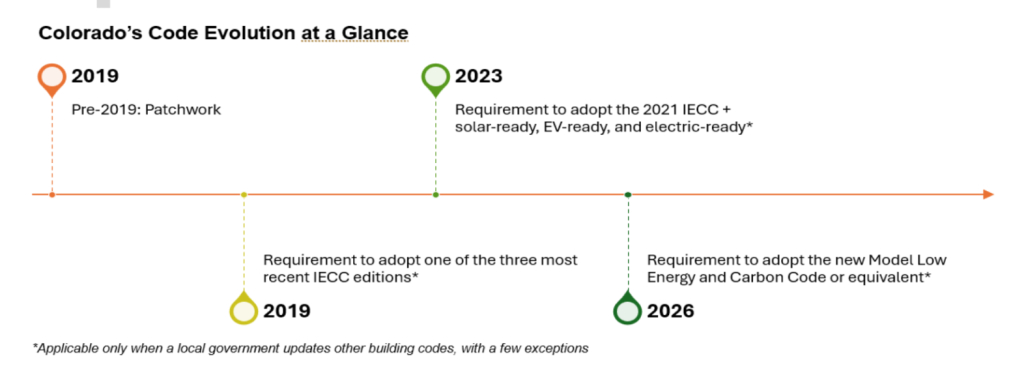
Colorado’s energy code landscape was once highly fragmented. Building code adoption decisions were entirely local and sporadic, leaving many jurisdictions on outdated energy codes, mismatched editions, or no energy code at all. This patchwork created lower-quality homes and poor-performing buildings; plus bureaucratic headaches for builders, who had to navigate inconsistent local requirements. While this challenge is common across the Southwest, Colorado chose a different path.
🏢 First leap (2019): A state/local hybrid approach
To begin shifting from purely local code adoption toward statewide minimums and increased consistency, the legislature passed HB19-1260, working closely with local officials to address the communities’ practical needs and concerns:
- Timing control: Local officials wanted to align energy code updates with their full building code package updates. HB19-1260 specified that statewide minimums applied only when other building codes were updated.
- Flexibility: Local officials wanted flexibility over what energy code would be required to be adopted since some were starting from very old or no codes. HB19-1260 allowed adoption of any of the previous three International Energy Conservation Code (IECC) editions (up to nine years old) and permitted local amendments as long as efficiency wasn’t weakened.
🏢 Second leap (2022): A true statewide minimum
In response to growing demand for modern high-performance codes, HB22-1362 strengthened the law through:

- Updating the minimum: Statewide baseline moved to the 2021 IECC, adding solar-ready, electric vehicle (EV) ready, and electric-ready provisions.
- Local alignment: The bill maintained the trigger system where new requirements applied only when local governments updated any other building codes, with an extra year for transition.
- Support for smaller jurisdictions: Introduced a recurring grant program for funding and free technical assistance for local governments to avoid “unfunded mandates” and challenges for smaller and rural jurisdictions.
🏢 Third leap (now): Collaboration over complexity
The same law paved the way for the most recent update: raising the statewide minimum to the Model Low Energy and Carbon Code. To ensure stakeholder input and avoid overly experimental provisions, the law requires:
- Creation of the Colorado Energy Code Board (ECB): 21 seats representing specific affected stakeholder groups, including urban and rural cities and counties, homebuilders, trades workers and unions, energy modelers, and more.
- Peer support: Each applicant had to provide a letter of support from a relevant statewide association to confirm industry backing.
- Grounded in proven standards: The code had to be based on the 2024 IECC, with no strengthening of any energy code provision beyond the base code or its appendices.
- Balanced goals: The ECB was required to improve affordability and emissions while simplifying complex provisions and addressing recurring challenges for builders and officials.
The new standard
The Model Low Energy and Carbon Code puts the state ahead and ensures every new building is prepared for a clean-energy future. This next-generation code improves energy efficiency by encouraging electrification measures, adding demand-response capabilities, and tackling home affordability. This new code will be required whenever a local government updates any other building code after July 1, 2026.
Colorado is not just keeping pace; it is defining what climate-conscious building policy looks like.
🏢 Key features of the commercial code
Colorado’s commercial energy code isn’t just about efficiency, it’s about readiness and systems thinking. By adopting the 2024 IECC’s strong energy efficiency provisions, vastly simplifying the most complicated code sections, removing requirements that added little value, changing to fuel-neutral and cost-neutral baselines, encouraging heat pump-based heating and water heating, and adding grid-responsive capabilities, the state ensures every new building is flexible enough to meet whatever the future holds.
- Demand response and load management: HVAC and water heating systems equipped with Automated Demand Response capability using OpenADR 2.0a/b.
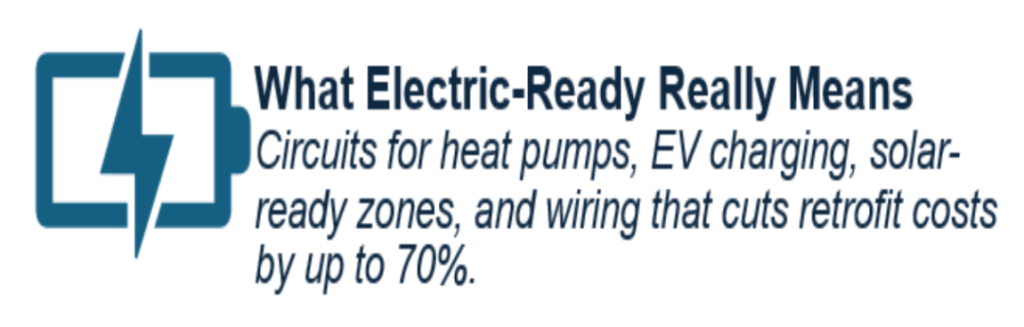
- Electric ready: Dedicated branch circuits for future electric appliances.
- Solar ready: At least 40% of roof area reserved for solar-ready zones (with exceptions).
- EV ready: Conduits, wiring, outlets, and/or full charging infrastructure to support EVs, based on the building type and developer preferences.
- Energy credit system: Vastly simplified calculations, and more options for obtaining credits such as low-GWP refrigerants or refrigerator doors.

🏢 Residential highlights
Colorado’s residential code ensures that new homes are built for long-term affordability and resilience. Key features include:
- Improved protection against severe weather through stronger air sealing and insulation.
- Stronger requirements for extra large homes, which use more energy per square foot and are unlikely to be affordable starter homes.
- Steps towards electrification including outlets and panel capacity for heat pumps, water heating, induction cooking, and dryers, fuel neutrality in the “baseline,” and additional credit for high-efficiency heat pumps and heat pump water heaters.
- Solar-ready provisions to make future PV installation feasible.
- EV-ready wiring for single-family homes, duplexes, and townhomes.
These measures dramatically reduce the cost and effort of future electrification, which is a win for homeowners and the grid.
The Southwest follows suit: Incremental steps to modernization
Colorado’s rapid progress is leading the region. While not as sweeping, Arizona, Nevada, and New Mexico are making meaningful, mandatory moves toward modern energy codes.
🏢 Arizona: Focusing on resiliency and compliance
Arizona’s energy code journey is shaped by its unique climate realities and its strong tradition of local control. While the state does not mandate a single statewide energy code, its cities and towns have become powerful drivers of progress, and the state is increasingly stepping in with data, analysis, and technical support to help them move forward.
Cities like Phoenix, Mesa, and Tucson are leading the charge, advancing adoption of the 2024 IECC and demonstrating that energy efficiency is not a partisan issue but a practical response to rising temperatures, growing populations, and increasing energy demand.
Arizona’s progress is also grounded in evidence. A U.S. Department of Energy field study is underway in the state, conducting blind reviews of new construction to identify areas of improvement and needs for training based on the adopted and enforced code in the sample dataset. This kind of data has become a powerful tool for local governments seeking to explain and justify code updates to builders, councils, and the public.
But perhaps the most defining feature of Arizona’s approach is its emerging focus on resiliency. In a state where extreme heat is not an abstract future threat but a lived reality, modern energy codes are increasingly seen as a public health measure. Arizona is exploring code provisions that help buildings maintain safe indoor temperatures during grid outages, heat waves, and other climate-driven events.
Arizona’s story is one of local leadership supported by state-level science — a model that blends autonomy with accountability and positions the state to make meaningful strides in the years ahead.
🏢 Nevada: The early adopter
Nevada’s path toward modern energy codes looks very different from Colorado’s — quieter, more procedural, but no less impactful. Where Colorado relied on sweeping legislative reform in several phases, Nevada built its progress on predictability. The state’s energy code evolution is anchored in a simple but powerful requirement: under NRS 701.220, the Governor’s Office of Energy (GOE) must adopt the most recent version of the IECC every three years. No drama, no stagnation, just steady reliable progress.
This triennial mandate has created one of the most consistent modernization cycles in the country. And in 2019, Nevada strengthened this system even further. Through amendments to NAC 701, the state streamlined the adoption process, eliminating the need for GOE to travel across Nevada’s vast rural landscape to hold multiple public hearings. Instead, the agency could focus its time and resources on what communities needed: technical assistance, training, and support.
The result is a state that quietly became an IECC pioneer. Nevada was among the first in the nation to adopt the 2021 IECC and moved swiftly to adopt the 2024 IECC at the state level, effective August 18, 2024. Many local jurisdictions in the state have adopted the 2024 IECC and will start enforcement on January 1, 2026.
Nevada’s story is one of steady, dependable leadership. It shows that sometimes the most transformative policy is the one that simply refuses to fall behind.
🏢 New Mexico: State-mandated progress
New Mexico has taken one of the most decisive steps in the region by establishing a mandatory statewide minimum energy code — a move that ensures every community, regardless of size or resources, builds to a modern efficiency standard.
In early 2024, New Mexico adopted the 2021 IECC for both residential and commercial buildings, with the statewide requirement taking effect on January 30. While some jurisdictions phased in compliance throughout the transition period that extended through July 30, 2025, enforcement is now mandatory across the state. This marks a significant shift from the persistently-out-of-date codes that previously defined New Mexico’s building energy code.
New Mexico also demonstrated a strong commitment to future-proofing by including sections of the Electric Vehicle Infrastructure Appendix in its base code. This ensures that new homes and buildings are prepared for the rapid growth of electric vehicles across the region.
Conclusion: The new standard for the Southwest
Progress across the American Southwest signals a fundamental shift in how we approach building policy. While the incremental steps taken by Arizona, Nevada, and New Mexico are crucial for establishing a stronger regional baseline, Colorado’s ambitious leaps show the true potential of policy leadership.

Colorado’s Model Low Energy and Carbon Code is not just an update; it’s a proactive strategy against decades of high energy costs and carbon emissions. By integrating electric-ready, solar-ready, and demand response features into the base code, Colorado is effectively eliminating future costly retrofits, a massive saving for consumers and a necessary step for climate resilience.
The lesson for the entire Southwest is clear: modern energy codes are the most powerful tool for rapidly reducing energy consumption and GHG emissions in the built environment while improving both health and comfort. As climate challenges intensify, all states must recognize that adopting the latest, highest-performing codes is no longer optional, it is essential for future-proofing their grids, their economies, and their communities.


