

May 1, 2025 | Neil Kolwey, Industrial Program Director & Building Electrification Specialist
———————————————————-
More and more homeowners are learning about heat pumps and their benefits for home heating and cooling. One of the common questions many people ask is whether heat pumps will help reduce energy costs compared with the more conventional heating and cooling technologies. We know that heat pumps lower annual heating bills by 50% or more compared to electric baseboard, propane, and fuel oil heating. But what about compared to a gas furnace?
The Southwest Energy Efficiency Project (SWEEP) has developed a calculator to help answer this question. It provides homeowners with information on the relative heating costs of heat pumps compared to gas furnaces, to help them make a more informed heat pump decision. It can also help contractors explain to homeowners their heat pump system options and relative costs. And it will help utilities and state and local policymakers improve programs and campaigns to promote residential heat pumps.
The calculator is very simple to use, requiring only three inputs:
- State
- Climate zone (the calculator includes a map of climate zones)
- HVAC replacement scenario (existing home system replacement, or new home/total home remodel)
With these three inputs, the calculator then provides an estimate of the percentage savings in annual heating costs for several heat pump system options compared to an existing (80% efficient) gas furnace. Secondly, it estimates the annual savings in cooling costs compared to a standard efficiency air conditioning (AC) system. And third, it estimates the reduction in carbon emissions with the heat pump systems compared to the gas furnace options, over a 15-year period.
There are two main factors in determining the relative heating costs for heat pumps vs. gas furnaces. The first is the efficiency of the equipment. For heat pumps, the calculator includes modeled efficiencies of several heat pump system types for each climate zone. For the gas furnace, the calculator assumes a rated efficiency of either 80% for existing furnaces (the minimum federal efficiency until 2015) or 95% for new furnaces (the most common choice for more efficient new furnaces).
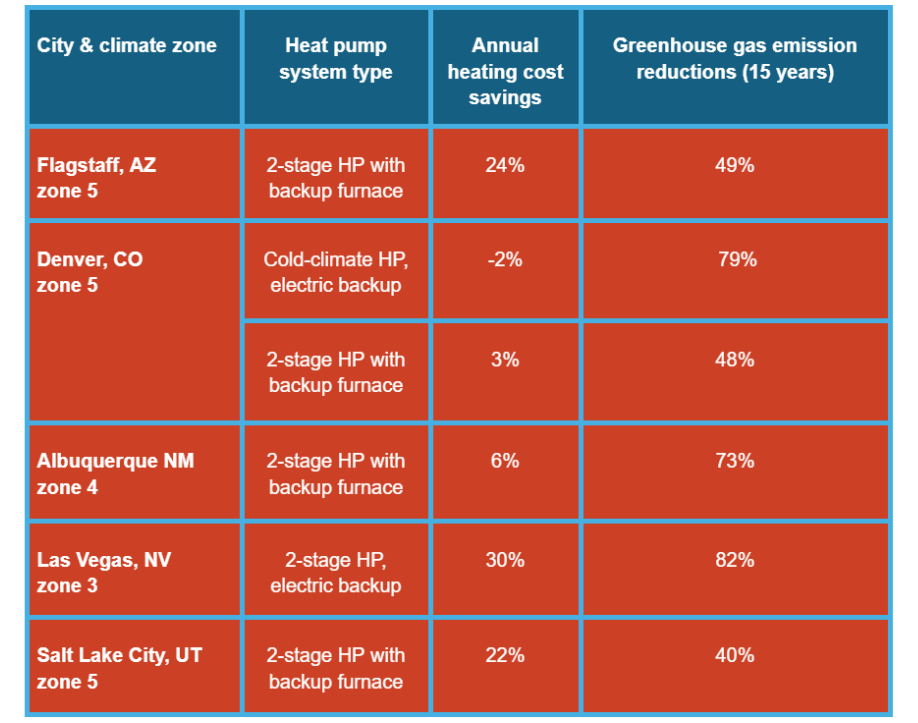
The second main factor is the relative price of electricity vs. gas for residential customers. For this, the calculator relies on the average electricity and gas prices for each state. However, it also allows customers to input their own electricity and gas prices. Of the Southwest states, the electricity-to-gas price ratio is most favorable for heat pumps in Arizona, Utah, Wyoming, and Nevada. For example, a new heat pump in an existing home in Las Vegas, Nevada will reduce heating costs compared to an existing gas furnace by about 30%. For Colorado and New Mexico, the electricity to gas price ratio is less favorable, but even in these states some of the heat pump options will reduce heating costs compared to existing gas furnaces. We highlight some results in the table below, for several cities in the Southwest states. For Denver, we present results for two heat pump systems, to highlight the differences in savings between cold-climate and dual-fuel heat pumps; the calculator provides this comparison for climate zones 4-6 in all states.
Sample results for Southwest cities, heat pump vs. existing gas furnace
You can find the calculator at thinkheatpump.org. This website also provides background information on heat pump system types, the calculator and instructions, and an explanation of the calculator’s main assumptions and methodology.
We encourage homeowners to try out the calculator, using the default state-average energy prices, as well as their own utility’s specific electricity and gas rates. A heat pump’s impact on your heating costs will vary depending on your location and rates, but in all locales, it will save you money on your cooling costs (assuming your home has an existing AC system that you would replace with the heat pump). And regardless of location, a heat pump will also significantly reduce your carbon emissions compared to a gas furnace.
Even if the results show your heating costs will stay about the same, you should still consider installing a heat pump. As mentioned in the heat pump system types page, if you are located in climate zone 4 or above, one option to improve heat pump economics is to increase the changeover temperature for dual-fuel heat pump systems (those with a backup gas furnace). The changeover temperature determines when the electric heat pump turns off and the backup furnace takes over. An increase of 10°F in the changeover temperature to the backup furnace, e.g., from 30°F to 40°F, can reduce heating costs with the heat pump by about 10%.
Generally, SWEEP recommends that all homeowners in the Southwest states install a new heat pump when replacing their AC system or when adding cooling in homes without central cooling. With current rebates and tax credits (including state, utility, and local, and potentially federal), a new heat pump will generally cost about the same as replacing the home’s AC system (or less). If you need to replace your gas furnace but your AC system is still in good shape, the economics will be a bit more challenging, but we still recommend considering the heat pump options. In addition, at the time of installing a new heat pump, we urge homeowners to make any needed energy efficiency improvements to their home, such as air sealing and insulation, to further reduce heating and cooling costs and to improve comfort. For electric utilities, SWEEP recommends offering generous rebates for heat pumps and promoting their cost savings, comfort, and carbon emissions benefits. In addition, we encourage utilities to provide a link to the SWEEP heat pump cost calculator on their websites. This tool will help customers feel more comfortable with the decision to install a new heat pump in their homes, by learning a little more about the heat pump system options, how much their heating costs will decrease, and that cooling costs and carbon emissions will decrease significantly.


